
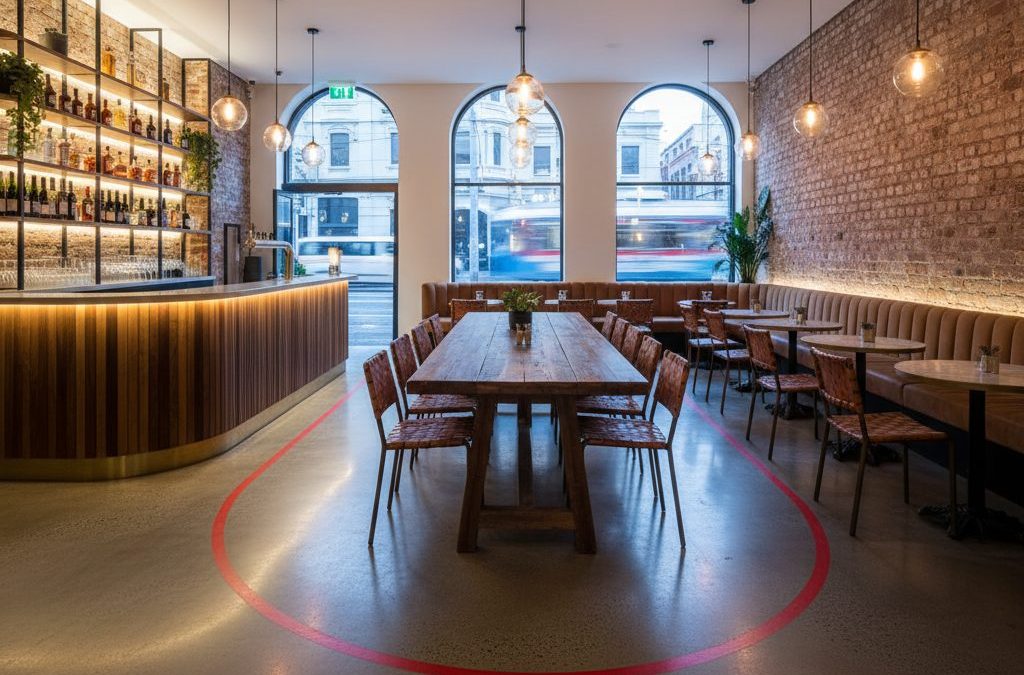
Running a successful hospitality venue in Melbourne is a dynamic art form. From the bustling CBD laneways to the vibrant strips of Chapel Street, Smith Street, Lygon Street, Brunswick Street, Fitzroy, Collingwood, Richmond, Carlton, and South Yarra, every establishment has its unique flavour and challenges. Whether you’re a cosy cafe looking to serve wine, a bustling restaurant expanding into outdoor dining, or a late-night bar revamping its layout, there’s one critical document that underpins your ability to operate: your liquor licence. And central to that licence are your Red Line Plans.
Quick answer: Red Line Plans directly affect liquor licence conditions by precisely defining the legally permissible area for liquor sale and consumption within a venue. Getting these detailed, scaled drawings correct from the outset is crucial for Victorian hospitality operators to avoid future time, money, and stress, as they form the binding blueprint for liquor licensing authorities.
At TJR Projects, we speak to hospitality operators every week who are either embarking on a new venture, expanding an existing one, or simply trying to understand the intricate world of liquor licensing in Victoria. We know firsthand that while the aroma of freshly brewed coffee or the clinking of cocktail glasses might be your passion, the paperwork can be a real headache. That’s where we come in.
Today, we’re diving deep into a topic that many find confusing but is absolutely essential: how your red line plan licence conditions are intrinsically linked, and why getting your Red Line Plan right from the outset can save you immense time, money, and stress down the track.
What Exactly is a Red Line Plan, and Why Does it Matter for Your Licence?
Let’s strip away the jargon and get to the core of it. A Red Line Plan, sometimes also referred to as a Licensed Premises Plan, is a highly detailed, scaled drawing of your venue. But it’s not just any drawing. This plan specifically and precisely defines the exact boundary of the area where liquor can be sold and consumed on your premises. Think of it as the legally binding blueprint that tells the authorities precisely where your liquor licence applies.
The Victorian Commission for Gambling and Liquor Regulation (VCGLR) is the authority responsible for granting and overseeing liquor licences in our state. When you apply for a new liquor licence, or if you propose any changes to your existing licensed premises – be it a renovation, an extension, or even a minor alteration to your layout – the VCGLR requires a Red Line Plan. This isn’t just a bureaucratic hurdle; it’s a fundamental tool for ensuring compliance and maintaining public safety and amenity.
The importance of these plans cannot be overstated. Your Red Line Plan directly informs and defines your red line plan licence conditions. These conditions are the specific rules and regulations attached to your liquor licence, dictating everything from your permitted trading hours to the areas where patrons can drink, and even the maximum patron capacity for specific zones within your venue. A poorly prepared or inaccurate Red Line Plan can lead to delays in your application, queries from the VCGLR, and even costly rectifications or, in severe cases, issues with your licence itself.
As registered Building Designers, we at TJR Projects specialise in preparing these VCGLR-compliant Red Line Plans. We understand the specific requirements and nuances that the VCGLR looks for, ensuring that your plan accurately reflects your proposed operations and aligns with the relevant sections of the Liquor Control Reform Act 1998 (Vic). This Act is the cornerstone of liquor regulation in Victoria, and every aspect of your licence, including the spatial definitions provided by your Red Line Plan, must adhere to its provisions.
The Critical Link Between Your Red Line Plan and Your Licence Conditions
Your Red Line Plan isn’t merely an attachment to your liquor licence application; it’s a living document that dictates the very parameters of your operation. The boundaries, authorised areas, and specific fixtures detailed on your plan directly translate into the conditions that govern your licence. Let’s explore this critical link in more detail:
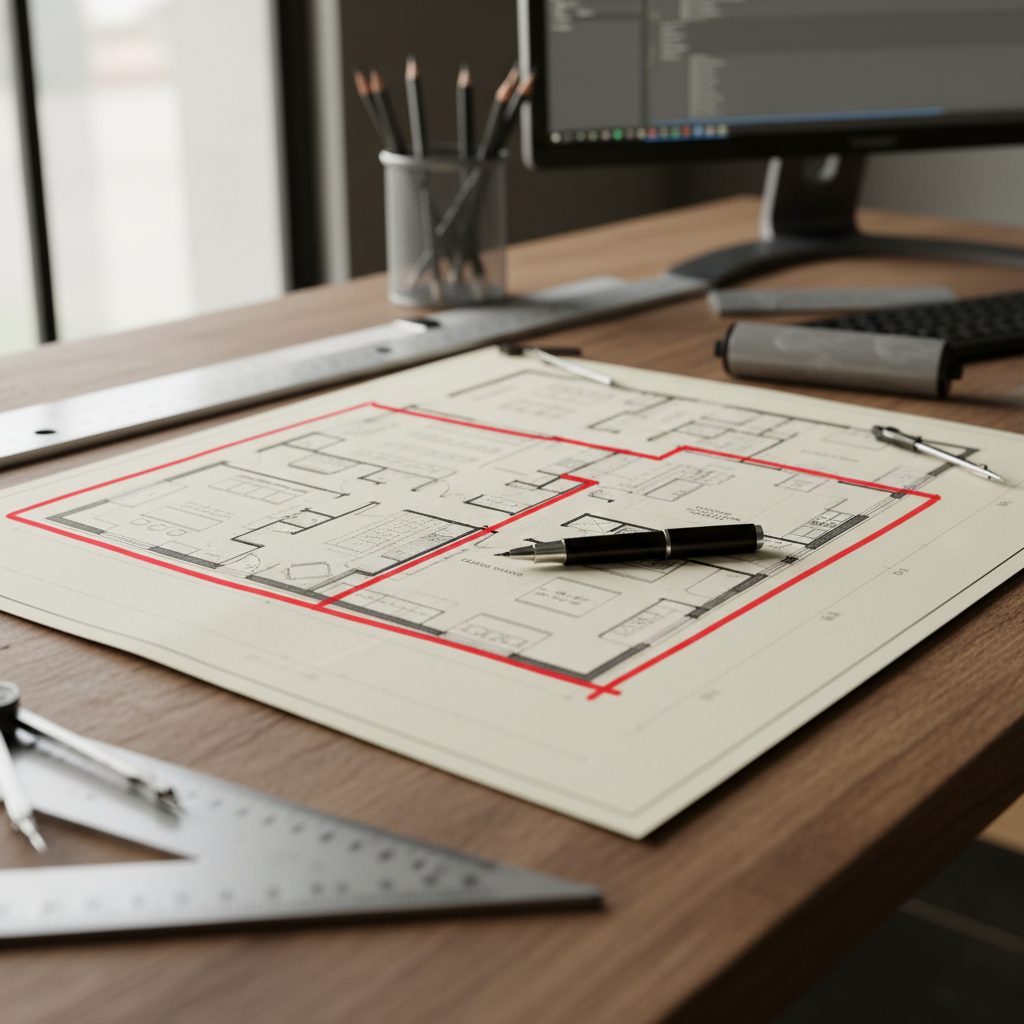
Firstly, the plan definitively establishes the ‘where’. If your Red Line Plan shows your licensed area extending into a footpath dining zone, then your licence conditions will permit liquor service in that exact outdoor space. If it doesn’t, then serving alcohol there would be a breach of your licence. This is particularly crucial in dense areas like Melbourne’s CBD laneways or the bustling outdoor dining scenes of Lygon Street in Carlton or Brunswick Street in Fitzroy, where every square metre counts and is often hotly contested. The plan precisely delineates public versus private space, and where your responsibility as a licensee begins and ends.
Secondly, the plan can influence the ‘what’ and ‘how’. For a packaged liquor licence in a bottle shop, the plan will clearly delineate the retail area where packaged liquor is sold for off-premises consumption. For a producer’s licence (like a craft brewery in Collingwood or a boutique distillery in Richmond), the plan will distinguish between the production area, the cellar door, and any on-premises consumption areas. The specific layout and designated areas on the plan help the VCGLR understand your intended mode of operation and tailor your licence conditions accordingly.
Consider a restaurant and cafe licence in South Yarra that wants to offer late-night dining and drinks. The Red Line Plan will clearly indicate the areas designated for on-premises consumption, potentially distinguishing between indoor and outdoor zones. If the venue then applies for a late-night licence, the VCGLR will scrutinise the existing Red Line Plan to ensure the proposed late-night area is clearly defined and suitable, potentially adding specific red line plan licence conditions relating to patron management, noise control, and security for those extended hours.
Consequences of Mismatches and Non-Compliance
What happens if your physical premises don’t match your Red Line Plan, or if you operate outside the boundaries defined by your plan and licence conditions? The consequences can range from inconvenient to severe:
- VCGLR Queries and Delays: Any discrepancy between your plan and reality, or a lack of clarity in your plan, will almost certainly lead to queries from the VCGLR. This means delays in your application process, which can be incredibly frustrating and costly, especially when you have opening dates or renovation schedules to meet.
- Breaches of Licence Conditions: Operating outside the boundaries defined by your approved Red Line Plan is a direct breach of your licence conditions. This could happen if you set up a temporary bar in an area not covered by your plan, or if your outdoor dining extends beyond the approved footprint. Breaches can lead to fines, formal warnings, or, in serious or repeated cases, suspension or even cancellation of your liquor licence.
- Legal and Insurance Issues: In the unfortunate event of an incident (e.g., an intoxicated patron, an accident), operating in an unlicensed area could expose your business to significant legal liability and potentially void your insurance coverage.
- Costly Rectifications: If your plan is rejected or deemed inadequate, you’ll need to pay for new plans to be drawn up, potentially delaying your project and adding unexpected expenses. As registered Building Designers, we strive to get your Licensed Premises Plans right the first time, helping you avoid these pitfalls.
This is why investing in professionally prepared Licensed Premises Plans is not just an expense, but an essential safeguard for your business. We ensure your plan is accurate, comprehensive, and aligns perfectly with your operational intentions and the VCGLR’s stringent requirements. For more insights into common pitfalls, you might find our recent post, Common Mistakes on Liquor Licence Plans That Cause VCGLR Delays, particularly helpful.
What Needs to Be on Your Red Line Plan? The VCGLR’s Requirements
To ensure your Red Line Plan is accepted by the VCGLR and accurately defines your red line plan licence conditions, it must include specific, detailed information. Think of it as a checklist that every professional Red Line Plan must satisfy:
- Clear Boundaries of the Licensed Area: This is the absolute core of the plan. The precise perimeter of where liquor can be sold and consumed must be clearly delineated, typically with a bold red line (hence the name!). This includes all indoor areas, outdoor dining spaces, designated smoking zones where liquor is permitted, and any other specific areas. This boundary must be fixed and immutable, and accurately reflect the physical reality of your venue. Our post, Boundary Definition on Red Line Plans: Getting It Right First Time, delves deeper into this crucial aspect.
- Authorised Areas for Liquor Consumption: Beyond the main boundary, the plan needs to identify specific areas where consumption is permitted. For example, a bottle shop with a tasting room will need to clearly mark the retail area for packaged liquor and a separate, smaller area for on-premises tastings. A hotel with multiple bars, restaurants, and function spaces will need each of these distinct areas clearly mapped out.
- Basic Fixtures and Layout: The plan must show the general layout of the premises, including fixed structures such as:
- Counters and bars (where liquor is served)
- Kitchens (especially for restaurant and cafe licences)
- Toilets
- Fixed seating areas
- Entry and exit points
- Any permanent internal divisions or walls
This helps the VCGLR understand the functionality and flow of your venue within the licensed area.
- Accurate Measurements and Scale: Every element on the plan must be drawn to an accurate, recognised scale (e.g., 1:100 or 1:200). Dimensions, square meterage of different areas, and distances must be precise. This is where professional drafting expertise is indispensable. Guesswork or hand-drawn sketches simply won’t cut it.
- North Point and Surrounding Streets: To correctly orient the premises, a north point must be included. Additionally, the plan should indicate adjacent streets and, where relevant, neighbouring properties, particularly if the licensed area abuts public land or other businesses. This provides crucial context for the VCGLR regarding the venue’s impact on its immediate environment.
- Proposed vs. Existing (for alterations): If you’re altering an existing licensed premises, your Red Line Plan will often need to show both the existing layout and the proposed changes, clearly highlighting the differences. This allows the VCGLR to easily assess the impact of your proposed alterations on your red line plan licence conditions.
The role of registered Building Designers in preparing these plans is crucial. We possess the technical drafting skills, the understanding of building codes, and the specific knowledge of VCGLR requirements to produce plans that are not only compliant but also clear, accurate, and professional. We ensure that every detail, from the exact placement of a bar to the precise measurement of an outdoor dining zone, is captured correctly, streamlining your application process.
Common Scenarios Where Your Red Line Plan Becomes Crucial
Let’s look at some real-world scenarios that Melbourne hospitality operators commonly face, illustrating just how vital a robust Red Line Plan is to defining your red line plan licence conditions and successful operation.
Setting Up a New Venue (e.g., CBD Laneway Wine Bar)
Imagine you’re opening a chic new wine bar tucked away in one of Melbourne’s iconic CBD laneways. These spaces are often compact, multi-level, and sometimes share common areas or have unique outdoor components. Your initial liquor licence application (likely an on-premises licence) hinges entirely on your Red Line Plan.
For a laneway wine bar, your plan will need to precisely define:
- The indoor bar area, seating, and any standing room.
- If you have a mezzanine or basement level, each of these must be clearly delineated as part of the licensed area, showing internal stairs and access points.
- Crucially, if you plan to have a few tables and chairs spill out onto the laneway, your Red Line Plan must accurately show this outdoor area, its exact dimensions, and how it relates to the public footpath. This usually requires a separate permit from the local council (e.g., City of Melbourne), which the VCGLR will also consider.
Without a clear and accurate Red Line Plan, the VCGLR cannot determine the appropriate patron capacity for your venue, nor can they set precise conditions for noise management or public amenity, particularly for that vital outdoor space. We work with clients to ensure these plans are not only compliant but also reflect the operational vision for their new establishment, anticipating potential issues before they arise.
Expanding or Renovating an Existing Operation (e.g., Chapel Street Cafe to Restaurant)
Consider a beloved cafe on Chapel Street, South Yarra, that has built a loyal following and now wants to expand its offering. They currently hold a restaurant and cafe licence but want to extend their trading hours to include dinner service, add a dedicated bar area, and significantly expand their outdoor dining into a newly acquired adjacent space. This isn’t just a simple renovation; it’s a change to the core of their licensed operations.
In this scenario, an updated Red Line Plan is absolutely essential. It will need to clearly show:
- The original licensed footprint.
- The new, expanded indoor dining and bar areas.
- The significantly larger outdoor dining zone, with its new boundaries and dimensions, demonstrating how it integrates with the existing premises and adheres to council requirements for outdoor dining.
The VCGLR will use this updated plan to assess the impact of these changes on the existing red line plan licence conditions. They might impose new conditions related to patron capacity for the enlarged outdoor area, revised operating hours for the bar, or specific requirements for security or noise management in the expanded zones. If the plan is inaccurate or unclear, the VCGLR might reject the amendment, or impose overly restrictive conditions that hinder the cafe’s growth ambitions. This is a common situation where our expertise in preparing Red Line Plans for liquor licence applications becomes invaluable.
Applying for a Producer’s Licence (e.g., Fitzroy Brewery)
Melbourne’s craft beer scene, particularly in areas like Fitzroy and Collingwood, is booming. A new brewery setting up shop will likely apply for a producer’s licence. This licence type has unique requirements, as it deals with both the production of liquor and, often, its on-premises consumption at a cellar door or tasting room.
For a brewery, the Red Line Plan will need to meticulously distinguish between:
- The brewing and production areas (where liquor is manufactured).
- Storage areas for raw materials and finished products.
- The cellar door or tasting room where liquor is sold for on-premises consumption.
- Any retail space where packaged liquor (e.g., six-packs, growlers) is sold for off-premises consumption.
- Often, specific areas for private functions or events within the brewery.
The VCGLR uses this detailed spatial information to set red line plan licence conditions that reflect the dual nature of a producer’s licence – ensuring the primary purpose remains production, while allowing for appropriate retail and consumption activities. Misrepresenting these areas on the plan could lead to significant issues, including restrictions on sales channels or on-site consumption, directly impacting the brewery’s business model.
Addressing VCGLR Queries or Compliance Issues
Sometimes, we get calls from operators who have received a query from the VCGLR or even a compliance notice. This could be due to a complaint from a neighbour about noise from an outdoor area, or an inspector noticing that an internal layout change doesn’t match the existing approved plan. In these situations, an accurate and professionally prepared Red Line Plan can be your most important defence.
If your current plan is outdated or inaccurate, we can swiftly prepare a new, compliant Red Line Plan that accurately reflects your current layout and operations. This allows you to demonstrate to the VCGLR that you understand your red line plan licence conditions and are taking steps to rectify any discrepancies. Having a clear, professional plan can often resolve issues quickly, avoiding further penalties or protracted investigations. It’s about proactive compliance, which is always more cost-effective than reactive damage control. Our expertise in navigating these challenges is why many choose TJR Projects for their Red Line Plan needs.
Navigating the Process: How TJR Projects Can Help
The world of liquor licensing and Red Line Plans can seem daunting, but it doesn’t have to be. At TJR Projects, we believe in making this process as straightforward and stress-free as possible for Melbourne’s hospitality operators. Our owner, Romanos, is a registered Building Designer with extensive experience in preparing Red Line Plans that meet and exceed VCGLR requirements.
Here’s how we can assist you:
- Expertise in VCGLR Requirements: We know exactly what the VCGLR looks for in a Red Line Plan. We stay up-to-date with the latest regulations and interpretations of the Liquor Control Reform Act 1998 (Vic), ensuring your plan is always compliant.
- Accurate and Detailed Drafting: Our team produces highly accurate, scaled drawings that meticulously define your licensed area, authorised consumption zones, and key fixtures. We use professional drafting software to create clear, precise, and unambiguous plans. This is a core part of our drafting process.
- Streamlined Application Process: By providing a VCGLR-ready plan, we help streamline your liquor licence application or amendment process, reducing the likelihood of delays and queries. This means you can focus on what you do best – running your hospitality business.
- Understanding of Diverse Venue Needs: From a small cafe in Brunswick East seeking an on-premises licence to a large function centre in Richmond needing to update its Red Line Plan, we have experience with a wide range of venue types and licence categories. We understand the specific nuances that apply to general, on-premises, restaurant and cafe, packaged liquor, producer’s, limited, and late-night licences.
- Problem Solving: If you’ve had a plan queried by the VCGLR or are unsure how to accurately represent complex changes to your premises, we can step in to provide solutions and prepare the necessary revisions. We’ve seen many scenarios and can help you navigate tricky situations. You might find our advice on How to Prepare a Red Line Plan That Gets Approved First Time particularly useful.
- Referrals to Liquor Licensing Town Planners: While we specialise in the technical drafting of Red Line Plans, we also recognise that liquor licence applications often involve broader town planning and legal considerations. We have a network of reputable liquor licensing town planners whom we can refer you to for end-to-end support, ensuring all aspects of your application are covered. This collaborative approach means you get comprehensive assistance from trusted professionals.
Ultimately, a professionally prepared Red Line Plan from TJR Projects means peace of mind. It means your red line plan licence conditions are clearly defined, understood, and adhered to. It means you can operate your Melbourne venue confidently, knowing you’ve met your regulatory obligations and set your business up for success.
Stuck on a Red Line Plan or had one queried by VCGLR? Send us a message — we deal with these every week and can usually turn things around quickly.
Related guides from TJR Projects
- Red Line Plans for Breweries, Distilleries and Cellar Doors
- Outdoor Dining and Footpath Trading: How They Affect Your Red Line Plan
- Red Line Plans for Function Centres and Event Venues in Melbourne
- Red Line Plans for Bottle Shops and Packaged Liquor Outlets
- Red Line Plans for Your Liquor Licence: What Melbourne Venues Need to Know
- Boundary Definition on Red Line Plans: Getting It Right First Time
- Common Mistakes on Liquor Licence Plans That Cause VCGLR Delays
- How to Prepare a Red Line Plan That Gets Approved First Time