
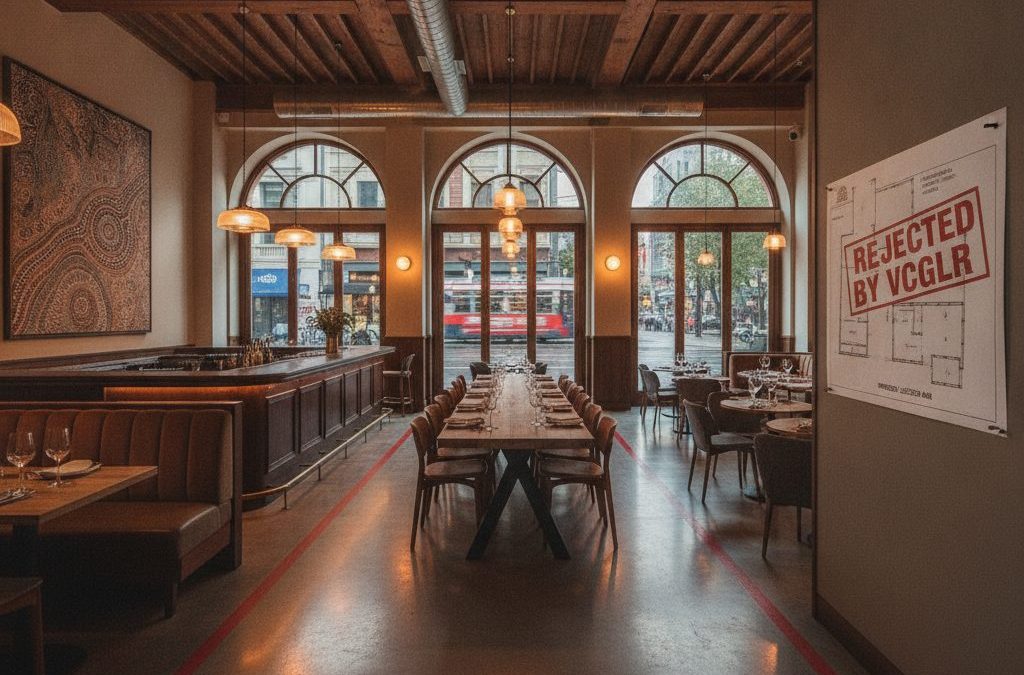
Melbourne’s hospitality scene is a vibrant, ever-evolving tapestry of flavours, experiences, and late-night possibilities. From the bustling laneway cafes of the CBD to the sophisticated wine bars of Fitzroy, the iconic dining rooms of Lygon Street, and the lively pubs of Chapel Street, our city thrives on new ventures and exciting expansions. But behind every successful opening or seamless operational shift lies a meticulous layer of planning, compliance, and, crucially, a document known as a Red Line Plan.
Quick answer: If your Red Line Plan is rejected by VCGLR, it causes significant delays, additional costs, and frustration for your liquor licence application. Rejection necessitates resubmission with corrections, potentially impacting opening timelines and operational readiness. Understanding VCGLR’s specific requirements and ensuring meticulous plan preparation is crucial to avoid this common roadblock and ensure a smooth licensing process.
Here at TJR Projects, we work closely with many of Melbourne’s finest hospitality operators, helping them navigate the complexities of architectural drafting and building design. As registered Building Designers, we’re particularly adept at preparing Red Line Plans (also known as Licensed Premises Plans) that meet the exacting standards of the Victorian Commission for Gambling and Liquor Regulation (VCGLR). We know that for hospitality owners, the thought of your liquor licence application hitting a snag is enough to trigger a cold sweat. And one of the most common, and potentially devastating, roadblocks you can encounter is having your Red Line Plan rejected by VCGLR.
It’s a scenario that no one wants to face: the delays, the additional costs, the sheer frustration. But what exactly happens if your Red Line Plan is rejected by VCGLR? And more importantly, how can you prevent it, or quickly recover if it does happen? Let’s dive deep into this critical aspect of liquor licensing, offering you practitioner-level insights from our years of experience helping Melbourne’s hospitality businesses thrive.
The Heart of the Matter: Why Your Red Line Plan is Critical (and Why VCGLR Rejects Them)
Before we explore the consequences of rejection, it’s vital to understand the fundamental role your Red Line Plan plays. It’s not just another piece of paper; it’s the legal blueprint that defines the very soul of your licensed operation.
Understanding the Purpose of a Red Line Plan
At its core, a Red Line Plan is a detailed drawing that precisely delineates the boundary of the area where liquor can be sold and consumed on your premises. Think of it as the official map for your liquor licence, clearly showing the VCGLR exactly where your patrons can enjoy a craft beer, a signature cocktail, or a glass of fine Australian wine.
These plans are an absolute requirement by the VCGLR for virtually all liquor licence applications and any subsequent changes to your venue’s layout or licensed area. Whether you’re applying for a new General Licence for a pub in Richmond, an On-Premises Licence for a new cafe in Carlton expanding into evening dining, a Packaged Liquor Licence for a bottle shop in South Yarra, or even a Producer’s Licence for a microbrewery in Collingwood, a compliant Red Line Plan is non-negotiable. It’s the visual representation of your compliance with the Liquor Control Reform Act 1998 (Vic) and its associated regulations.
We, as registered Building Designers at TJR Projects, prepare these plans with meticulous attention to detail, ensuring they align perfectly with VCGLR requirements. This includes clearly marking boundaries, identifying authorised areas (e.g., bar, dining room, outdoor seating), basic fixtures like bars and service areas, and, crucially, accurate measurements that leave no room for ambiguity. For a deeper dive into the ‘what’ and ‘why’, you might find our previous post, What Is a Red Line Plan and Why Does VCGLR Require One?, particularly insightful.
Common Reasons for Red Line Plan Rejection
So, why would the VCGLR look at your carefully submitted plan and send it back with a big red ‘NO’? From our experience, the reasons for a is a setback. The immediate fallout can be felt across multiple aspects of your business, from your finances to your reputation.

The most immediate and universal consequence is delay. Every day your application is held up is a day closer to your planned opening that you can’t trade, or a day longer you have to operate under outdated licence conditions. For a new venture, this can mean pushing back your grand opening, rescheduling staff, cancelling launch events, and missing out on crucial initial revenue. For an existing business looking to expand or change its operations – perhaps adding a new beer garden in Brunswick Street or expanding a bottle shop in Fitzroy – it means those exciting new revenue streams remain on hold.
This delay inevitably leads to financial implications. You’re likely still paying rent, utilities, and perhaps even staff wages for a venue that isn’t generating income. Interest on loans continues to accrue. Marketing campaigns might need to be paused or rescheduled, incurring further costs. For many hospitality businesses, especially startups or those operating on tight margins, these unplanned expenses can be incredibly stressful and, in some cases, even jeopardise the viability of the entire project.
Beyond the tangible costs, there’s the less quantifiable but equally significant impact of operational uncertainty and stress. As an owner, you’re juggling countless balls – suppliers, staff training, marketing, fit-out – and a rejected Red Line Plan adds a heavy, unexpected burden. It can create a sense of anxiety and disorganisation that trickles down to your team, affecting morale and confidence. Your carefully planned timeline is thrown into disarray, forcing a scramble to re-evaluate every subsequent step.
Digging Deeper: The Ripple Effect of a VCGLR Rejection
In Melbourne’s competitive hospitality landscape, where word travels fast, maintaining a smooth, professional image is paramount. A licensing hiccup, even if eventually resolved, can cast a shadow on your initial launch or expansion.
A Melbourne Tale of Two Plans: A Scenario
Let’s illustrate these points with a couple of realistic scenarios we’ve seen play out in our beloved city.
Scenario 1: The Fitzroy Wine Bar Fiasco
Imagine a passionate sommelier, let’s call her Chloe, deciding to open her dream wine bar in a beautifully renovated space off Brunswick Street, Fitzroy. She’s secured an On-Premises Licence and a Late-Night Licence for her intimate venue, complete with a small, enclosed outdoor courtyard. She engages an architect for the fit-out, who, in turn, provides the Red Line Plan as part of the broader documentation package. However, the architect, while brilliant at design, isn’t a specialist in liquor licensing plans.
Chloe submits her application, eagerly anticipating her grand opening in six weeks. Two weeks later, the dreaded email arrives: her drafting process.
Our registered Building Designer meticulously prepares the updated Licensed Premises Plan. We ensure the new outdoor area is clearly defined with precise measurements, showing its relationship to the footpath and neighbouring properties. We mark the proposed barriers, seating, and service points. We also double-check that the plan aligns perfectly with his existing planning permit for outdoor dining and his intended operational changes, including specific hours for the outdoor area.
Michael submits his application with confidence. Because the plan is accurate, complete, and fully compliant with VCGLR requirements, it sails through the initial review. His licence amendment is approved within the expected timeframe, allowing him to launch his evening bistro and outdoor dining experience precisely when planned, capitalising on the summer rush. He avoided the stress and financial hit that Chloe faced, all because he invested in getting his Red Line Plan right the first time.
These stories highlight that while a , don’t despair. While it’s a setback, it’s not the end of the road. Here’s a clear, practitioner-level guide on how to navigate the aftermath and get your application back on track.
Step-by-Step Guide to Rectification
- Review the VCGLR Feedback Carefully: The VCGLR will typically provide specific reasons for the rejection. This feedback is your roadmap. Read it thoroughly and understand exactly what needs to be changed or added. Don’t guess; if something is unclear, make a note to seek clarification.
- Identify the Errors and Discrepancies: Compare the VCGLR’s feedback against your submitted plan. Pinpoint every single issue. Is it an inaccurate measurement? A missing detail? An unclear boundary? A requirement for a specific licence type that wasn’t addressed?
- Engage a Professional (if you haven’t already): This is where TJR Projects comes in. If you prepared the plan yourself or used someone unfamiliar with VCGLR specific requirements, now is the time to bring in the experts. We can quickly assess the feedback, identify the root causes of the rejection, and advise on the necessary revisions. Our experience means we know exactly what the VCGLR is looking for.
- Make the Necessary Revisions: Based on the VCGLR feedback and professional advice, revise your Red Line Plan. This might involve re-measuring parts of your premises, adding previously omitted details (like a designated smoking area or specific points of sale for a Packaged Liquor Licence), clarifying boundaries, or adjusting the scale.
- Double-Check for Compliance: Before resubmitting, ensure the revised plan addresses ALL the points raised by the VCGLR. It’s also a good idea to cross-reference it with the broader requirements for your specific licence type (e.g., General, On-Premises, Limited, Late Night) and the Liquor Control Reform Act 1998 (Vic). This proactive step can prevent further rejections.
- Resubmit with a Clear Explanation: When you resubmit, clearly indicate that it’s a revised plan addressing previous feedback. If possible, include a cover letter or notation explaining how each point of concern has been addressed. This makes the VCGLR’s job easier and can expedite the review process.
The Value of Professional Expertise
This is where firms like TJR Projects truly shine. As registered Building Designers, we don’t just draw lines; we understand the legal and operational implications of every detail on your plan. We know the specific nuances that the VCGLR looks for, often anticipating potential issues before they even arise. When your VCGLR-compliant Red Line Plans, we also understand that liquor licensing is a multi-faceted process. That’s why we can refer clients to reputable liquor licensing town planners. These specialists can provide end-to-end support for your entire liquor licence application, from initial strategy and public notice requirements to full submission management, working hand-in-hand with our precise Red Line Plans.
Prevention is Better Than Cure: Getting It Right the First Time
The best way to avoid the headache of having your Red Line Plans for Restaurants and Cafes: What VCGLR Wants to See, covers some licence-specific details.
For a comprehensive guide, we highly recommend reading our detailed article, How to Prepare a Red Line Plan That Gets Approved First Time.
Our Role and Referrals
At TJR Projects, our role is to demystify this process for you. Romanos, our owner, is a registered Building Designer, meaning we bring a professional, regulated standard of practice to every Red Line Plan we produce. We combine our drafting expertise with a deep understanding of VCGLR requirements to create accurate, compliant, and approval-ready plans. We’re not just drawing; we’re problem-solving and risk-mitigating.
We work with a wide range of Melbourne hospitality operators – from new cafes expanding in Lygon Street, to established function centres updating their Red Line Plans in South Yarra, to breweries in Brunswick applying for producer’s licences. Our goal is always the same: to provide you with the documentation you need to get your liquor licence approved smoothly and efficiently.
And as mentioned, if you need broader liquor licensing support, we have strong relationships with specialist liquor licensing town planners. They can manage the entire application process, ensuring all legal and community consultation requirements are met, while we focus on delivering the perfect Licensed Premises Plans. This collaborative approach ensures all bases are covered, from architectural accuracy to legal compliance, reducing the chances of having your Red Line Plan rejected by VCGLR.
Should you ever need to revise your plan due to operational changes or VCGLR requirements, we also have you covered. Check out our guide on Updating Your Red Line Plan: When VCGLR Requires a Revision for more information on how we can assist with ongoing compliance.
Opening a venue, expanding your licensed area, or moving an outdoor dining footprint? Have a chat with our team about getting your Red Line Plan sorted.